Haldenorialia
Arc Deck
Arc Deck
Couldn't load pickup availability
Self-paced learning overview
- 📩 Digital file available after purchase
- 📚 Long-term availability
- 🔒 Secure checkout
- 🗓️ Content updated in 2026
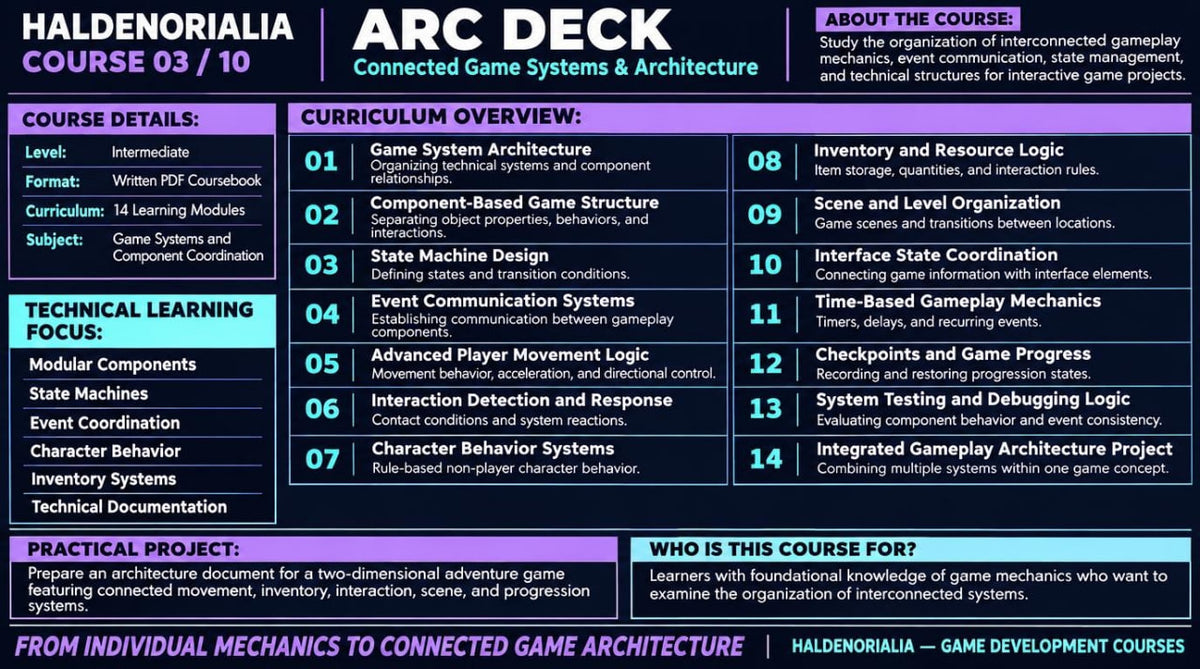
Level: Intermediate
1. Problem Statement
As a game project develops beyond individual fundamental mechanics, organizing interactions between different systems becomes increasingly important. Characters, objects, events, completion conditions, and interface elements need to exchange information according to defined rules. A poorly organized structure may lead to conflicting states, repeated event execution, and unpredictable responses from the game environment. Adding new mechanics also requires an understanding of how changes in one component influence other parts of the game. Further study of game development therefore involves exploring modular organization, state management, and system design principles.
2. Solution
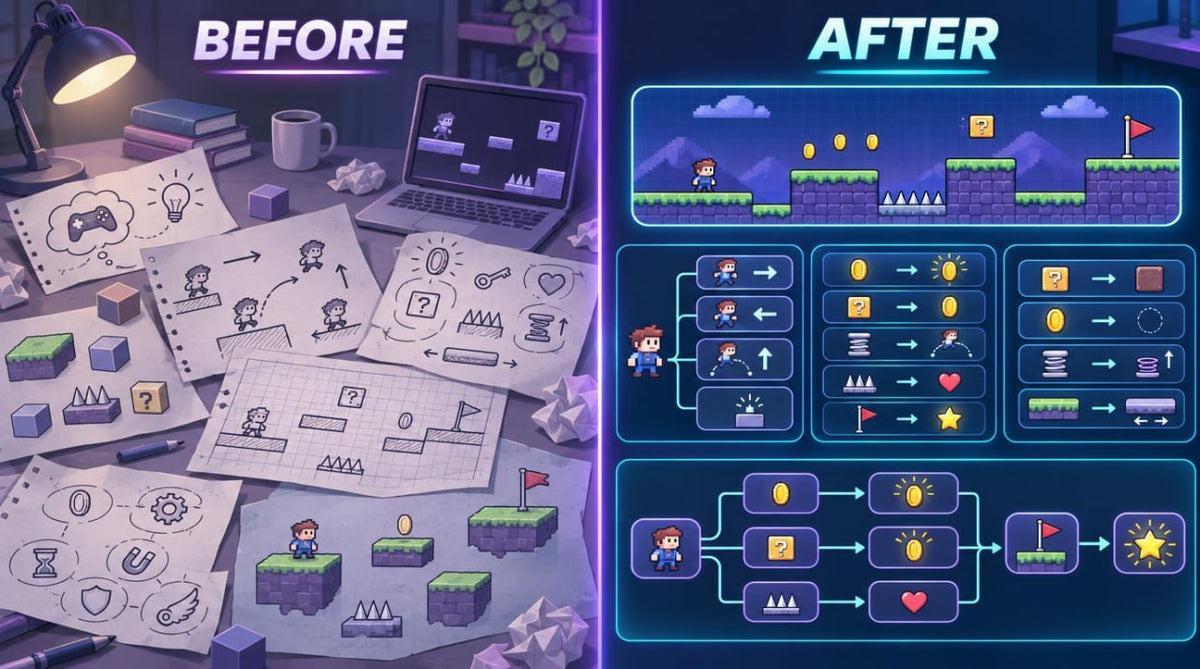
Arc Deck provides a structured examination of methods for organizing interconnected game systems. Its learning modules explain how gameplay logic can be divided into components, how responsibilities can be assigned, and how event communication rules can be established. Examples demonstrate the design of state systems, character behavior, interaction processing, and the preservation of important gameplay information. Practical exercises invite learners to analyze technical scenarios, prepare component diagrams, and evaluate the consistency of game rules. These materials support the study of interactive project structures and encourage learners to examine technical decisions as elements of a connected system.
3. What's Inside
Module 1: Game System Architecture
Explore principles for dividing a game project into logical components with defined responsibilities and relationships.
Module 2: Component-Based Game Structure
Examine methods of organizing game objects through separate behavior, property, and interaction components.
Module 3: State Machine Design
Study state models for characters and objects, including defined conditions for transitions between different states.
Module 4: Event Communication Systems
Learn how events can be communicated between components without creating excessive dependencies between their internal logic.
Module 5: Advanced Player Movement Logic
Explore movement mechanics involving acceleration, inertia, directional changes, and character responses to environmental conditions.
Module 6: Interaction Detection and Response
Analyze rules for detecting contact between objects, checking interaction conditions, and executing corresponding actions.
Module 7: Character Behavior Systems
Examine fundamental models of automated non-player character behavior based on states and predefined rules.
Module 8: Inventory and Resource Logic
Study methods of organizing game item storage, updating quantities, and evaluating conditions for item usage.
Module 9: Scene and Level Organization
Explore approaches to dividing game environments into individual scenes and managing transitions between them.
Module 10: Interface State Coordination
Examine the relationship between gameplay events and the information presented through interface elements.
Module 11: Time-Based Gameplay Mechanics
Study timers, delays, recurring events, and duration rules governing specific gameplay actions.
Module 12: Checkpoints and Game Progress
Explore methods of recording important game states and restoring gameplay from defined checkpoints.
Module 13: System Testing and Debugging LogicLearn techniques for reviewing components, analyzing event sequences, and documenting inconsistencies in system behavior.
Module 14: Integrated Gameplay Architecture Project
Prepare a technical plan for a small game with connected movement, event, interaction, resource, and progression systems.
4. Who Is This For?
✅ Suitable if you:
- Are familiar with the fundamental principles of game development and want to explore more complex systems.
- Understand the purpose of gameplay mechanics, states, and events.
- Are interested in organizing logic between multiple interconnected components.
- Want to explore modular game project structures.
- Plan to work with character behavior, inventory, levels, and interface logic.
- Would like to prepare technical diagrams describing game systems.
- Prefer written explanations supported by examples and practical exercises.
- Want to develop skills in analyzing the behavior of interactive systems.
❌ Not for you if you:
- Are unfamiliar with game objects, mechanics, and event concepts.
- Are looking exclusively for an introductory explanation of how digital games work.
- Want to focus entirely on character artwork and environmental illustration.
- Expect a complete large-scale game project without independently working on its components.
- Require individual instructor-led sessions.
- Are seeking materials focused exclusively on complex networking or multiplayer systems.
5. What You'll Learn
Arc Deck examines technical and design skills related to organizing interconnected game systems.
- Modular architecture: Dividing game logic into components with clearly defined responsibilities.
- State system design: Describing game object states and the rules governing transitions between them.
- Event coordination: Establishing relationships between gameplay actions, conditions, and system responses.
- Movement organization: Analyzing movement mechanics, acceleration, and changes in character behavior.
- Interaction systems: Designing logical rules for contact detection, condition checks, and responses between objects.
- Non-player character behavior: Preparing diagrams for basic automated decisions and transitions between behavioral states.
- Inventory organization: Defining rules for collecting, storing, using, and removing game items.
- Level structure: Designing individual scenes and the logic connecting different parts of a game environment.
- Interface coordination: Describing methods of displaying gameplay states, resources, and system messages.
- Time-based mechanics: Organizing delays, timers, and recurring events.
- Checkpoint systems: Identifying the information required to record and restore gameplay states.
- Logic evaluation: Preparing test scenarios to identify conflicts between game components.
- Technical documentation: Creating diagrams, state tables, and descriptions of system interactions.
- Integrated game design: Combining individual gameplay mechanics into the structure of a small game project.
6. Refund Policy
14-Day Refund Request Period
Refund requests for the Arc Deck course are reviewed according to the published Haldenorialia store policy and applicable law.
1. What format are the learning materials provided in?
1. What format are the learning materials provided in?
Haldenorialia courses are presented as written PDF coursebooks containing themed modules, explanations of technical concepts, examples, and practical exercises. The materials are organized for independent study, allowing learners to revisit individual topics and work through them at their own pace.
2. Do I need previous game development knowledge?
2. Do I need previous game development knowledge?
This depends on the course you choose. Introductory materials explain foundational game development concepts, while later courses explore more complex technical and design topics. We recommend reviewing the module descriptions and course subjects before making your selection.
Share