Haldenorialia
Echo Stage
Echo Stage
Couldn't load pickup availability
Self-paced learning overview
- 📩 Digital file available after purchase
- 📚 Long-term availability
- 🔒 Secure checkout
- 🗓️ Content updated in 2026
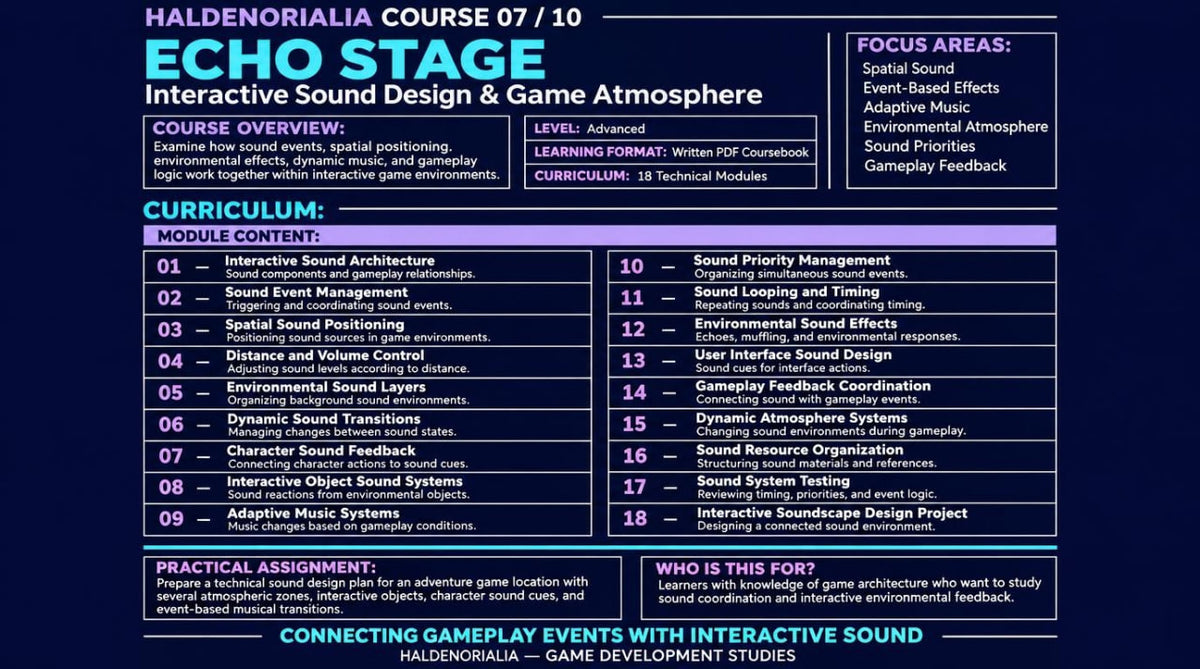
Level: Advanced
1. Problem Statement
Sound design for digital games requires thoughtful interaction between gameplay events, characters, and surrounding environments. Developing complex scenes introduces questions about synchronizing sound cues, determining their spatial positions, and managing multiple effects played simultaneously. Poorly organized systems can cause repeated sound triggers, inconsistent volume balance, and mismatches between player actions and environmental responses. Additional challenges arise when creating dynamic atmospheres that change according to locations, active events, and current gameplay states. Organizing these mechanics requires an understanding of sound architecture, spatial signal processing, and interactive component coordination.
2. Solution
Echo Stage provides a structured exploration of principles for designing sound systems in digital games. Its learning modules explain methods of organizing sound events, spatial positioning, volume management, and dynamic atmospheric compositions. Technical examples demonstrate relationships between character actions, environmental states, gameplay mechanics, and corresponding sound responses. Practical exercises involve designing sound component diagrams, analyzing scenarios, and evaluating synchronization between different elements. The materials support the study of methods for integrating sound design with interactive game world logic.
3. What's Inside
Module 1: Interactive Sound Architecture
Explore the structure of sound components and their interactions with gameplay systems.
Module 2: Sound Event Management
Examine methods of starting, stopping, and coordinating sound effects according to gameplay events.
Module 3: Spatial Sound Positioning
Study principles of positioning sound sources within two-dimensional and three-dimensional environments.
Module 4: Distance and Volume Control
Explore rules for changing signal volume according to the distance between a sound source and listener.
Module 5: Environmental Sound Layers
Examine methods of combining background sounds to create atmospheres for different gameplay locations.
Module 6: Dynamic Sound Transitions
Study gradual changes in sound design during transitions between gameplay states.
Module 7: Character Sound Feedback
Explore connections between character movement, interactions, actions, and corresponding sound cues.
Module 8: Interactive Object Sound Systems
Design rules for playing sounds when interacting with items, mechanisms, and environmental objects.
Module 9: Adaptive Music Systems
Examine principles of changing musical segments according to events, locations, and gameplay phases.
Module 10: Sound Priority Management
Study methods of determining signal importance and playback order when multiple sounds occur simultaneously.
Module 11: Sound Looping and Timing
Explore rules for repeating sound segments and synchronizing them with game timing intervals.
Module 12: Environmental Sound Effects
Examine methods of organizing echoes, muffling, and other sound changes within different environments.
Module 13: User Interface Sound Design
Study the use of sound cues for confirming commands, switching interface elements, and communicating events.
Module 14: Gameplay Feedback Coordination
Explore relationships between sound cues, visual responses, and gameplay state changes.
Module 15: Dynamic Atmosphere Systems
Design mechanics for changing environmental sound according to active events and gameplay conditions.
Module 16: Sound Resource Organization
Study principles of grouping, storing, and using sound materials within a game project.
Module 17: Sound System Testing
Analyze playback scenarios, priorities, synchronization, and possible logical inconsistencies.
Module 18: Interactive Soundscape Design Project
Prepare a technical concept for a gameplay location featuring spatial sounds, dynamic music, and event-based responses.
4. Who Is This For?
✅ Suitable if you:
- Already understand game system architecture.
- Are familiar with gameplay events and states.
- Want to explore interactive sound systems.
- Are interested in creating atmospheres for digital games.
- Want to study spatial sound positioning.
- Plan to design dynamic sound responses.
- Want to understand coordination between sound and visual elements.
- Prefer written educational materials with practical examples.
❌ Not for you if you:
- Are beginning your introduction to game development.
- Are unfamiliar with foundational gameplay logic.
- Are looking exclusively for graphical modeling instruction.
- Want to focus only on character movement programming.
- Expect a ready-made sound composition library instead of educational materials.
- Require individual instructor-led sessions.
5. What You'll Learn
- Sound system architecture.
- Sound event management.
- Spatial sound positioning.
- Dynamic music transitions.
- Character sound responses.
- Atmospheric effect organization.
- Sound and gameplay coordination.
- Sound mechanic testing.
6. Refund Policy
14-Day Refund Request Period
Refund requests for Echo Stage are reviewed according to the published Haldenorialia store policy and applicable law.
1. What format are the learning materials provided in?
1. What format are the learning materials provided in?
Haldenorialia courses are presented as written PDF coursebooks containing themed modules, explanations of technical concepts, examples, and practical exercises. The materials are organized for independent study, allowing learners to revisit individual topics and work through them at their own pace.
2. Do I need previous game development knowledge?
2. Do I need previous game development knowledge?
This depends on the course you choose. Introductory materials explain foundational game development concepts, while later courses explore more complex technical and design topics. We recommend reviewing the module descriptions and course subjects before making your selection.
Share