Haldenorialia
Neon Stage
Neon Stage
Couldn't load pickup availability
Self-paced learning overview
- 📩 Digital file available after purchase
- 📚 Long-term availability
- 🔒 Secure checkout
- 🗓️ Content updated in 2026
Level: Advanced
1. Problem Statement
Modern game environments can contain numerous objects, characters, and mechanics whose behavior depends on player actions. Designing these systems requires thoughtful management of events, character states, interaction conditions, and environmental changes. Without organized behavioral logic, non-player characters may respond inconsistently, while events may occur at inappropriate moments. Additional challenges arise when coordinating multiple scenarios that change according to completed objectives and previous player decisions. Designing these interactive systems requires an understanding of automated behavior, logical planning, and interactions between game components.
2. Solution
Neon Stage provides a structured exploration of methods for designing dynamic game systems. The learning modules explain behavioral models, decision-making systems, event management, and interactive scenario structures. Technical examples demonstrate how non-player characters can respond to environmental changes, navigate between locations, and perform defined actions. Practical exercises involve preparing behavior diagrams, analyzing scenario conditions, and evaluating interactions between individual systems. The materials support the exploration of game environments in which different components respond consistently to events and player decisions.
3. What's Inside
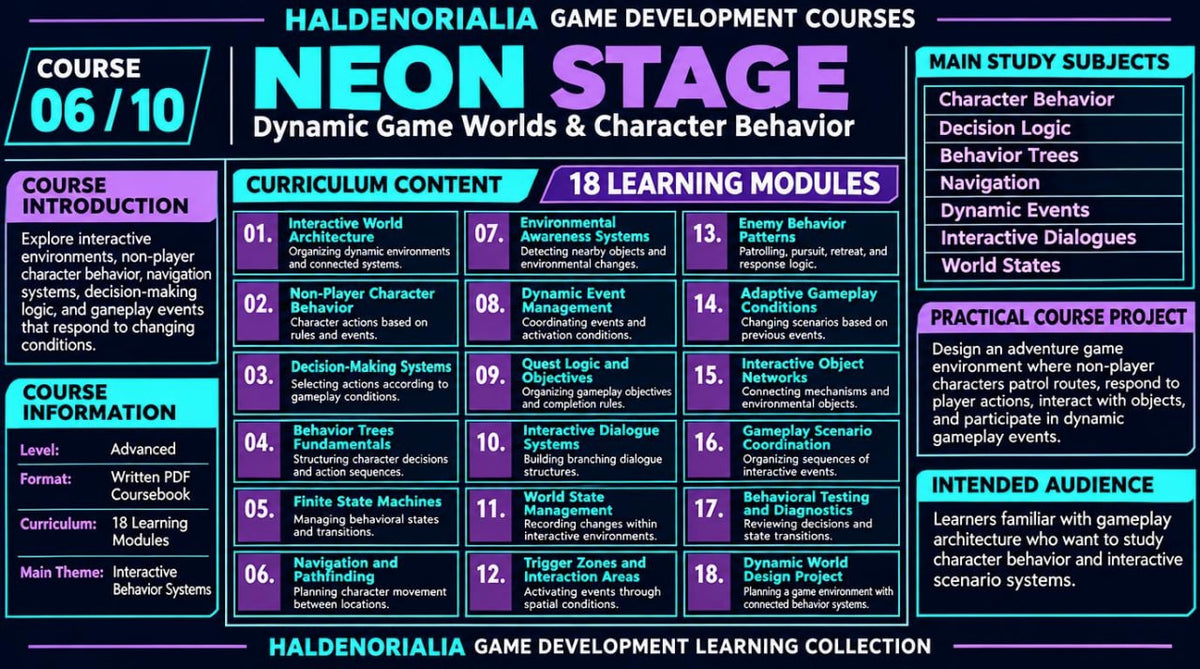
Module 1: Interactive World Architecture
Explore principles for organizing game environments with dynamic objects and interconnected systems.
Module 2: Non-Player Character Behavior
Examine methods of defining character actions according to states, conditions, and events.
Module 3: Decision-Making Systems
Study logical models for selecting actions based on predefined rules and current environmental conditions.
Module 4: Behavior Trees Fundamentals
Explore the structure of behavior trees for organizing sequences of character actions.
Module 5: Finite State Machines
Examine transitions between behavioral states and the conditions that activate them.
Module 6: Navigation and Pathfinding
Study methods of determining character movement routes between locations in a game environment.
Module 7: Environmental Awareness Systems
Explore methods of detecting objects, distances, obstacles, and gameplay events.
Module 8: Dynamic Event Management
Examine rules for initiating, completing, and coordinating events based on gameplay conditions.
Module 9: Quest Logic and Objectives
Design objective systems with defined completion conditions, checks, and state changes.
Module 10: Interactive Dialogue Systems
Explore dialogue structures featuring response options and logical transitions.
Module 11: World State Management
Study methods of preserving information about environmental changes, objects, and completed objectives.
Module 12: Trigger Zones and Interaction Areas
Examine mechanics that initiate events when characters enter defined areas.
Module 13: Enemy Behavior Patterns
Design logic for patrolling, pursuing, retreating, and responding to player actions.
Module 14: Adaptive Gameplay Conditions
Explore ways gameplay scenarios can change according to defined parameters and previous events.
Module 15: Interactive Object Networks
Study methods of coordinating switches, doors, mechanisms, and other interconnected elements.
Module 16: Gameplay Scenario Coordination
Organize event sequences, transitions, and responses between different game systems.
Module 17: Behavioral Testing and Diagnostics
Analyze decision-making scenarios, evaluate state transitions, and identify logical inconsistencies.
Module 18: Dynamic World Design Project
Prepare a technical concept for an interactive environment featuring characters, objectives, and event systems.
4. Who Is This For?
✅ Suitable if you:
- Already understand game system architecture.
- Are familiar with states, events, and gameplay logic.
- Want to study non-player character behavior.
- Are interested in creating interactive environments.
- Want to explore navigation and decision-making algorithms.
- Plan to design objective and dialogue systems.
- Want to understand dynamic scenario organization.
- Prefer written educational materials with technical examples.
❌ Not for you if you:
- Are beginning your introduction to game development.
- Are unfamiliar with fundamental state and event concepts.
- Are looking exclusively for game artwork instruction.
- Want to focus only on animation creation.
- Expect a completed game without independent assignments.
- Require individual instructor-led sessions.
5. What You'll Learn
- Interactive environment architecture.
- Character behavior logic.
- Behavior trees and state machines.
- Navigation algorithms.
- Dynamic event management.
- Quest and dialogue systems.
- Gameplay scenario coordination.
- Behavioral system testing.
6. Refund Policy
14-Day Refund Request Period
Refund requests for Neon Stage are reviewed according to the published Haldenorialia store policy and applicable law.
1. What format are the learning materials provided in?
1. What format are the learning materials provided in?
Haldenorialia courses are presented as written PDF coursebooks containing themed modules, explanations of technical concepts, examples, and practical exercises. The materials are organized for independent study, allowing learners to revisit individual topics and work through them at their own pace.
2. Do I need previous game development knowledge?
2. Do I need previous game development knowledge?
This depends on the course you choose. Introductory materials explain foundational game development concepts, while later courses explore more complex technical and design topics. We recommend reviewing the module descriptions and course subjects before making your selection.
Share