Haldenorialia
Vibe Set
Vibe Set
Couldn't load pickup availability
Self-paced learning overview
- 📩 Digital file available after purchase
- 📚 Long-term availability
- 🔒 Secure checkout
- 🗓️ Content updated in 2026
Level: Beginner to Practical Game Design
1. Problem Statement
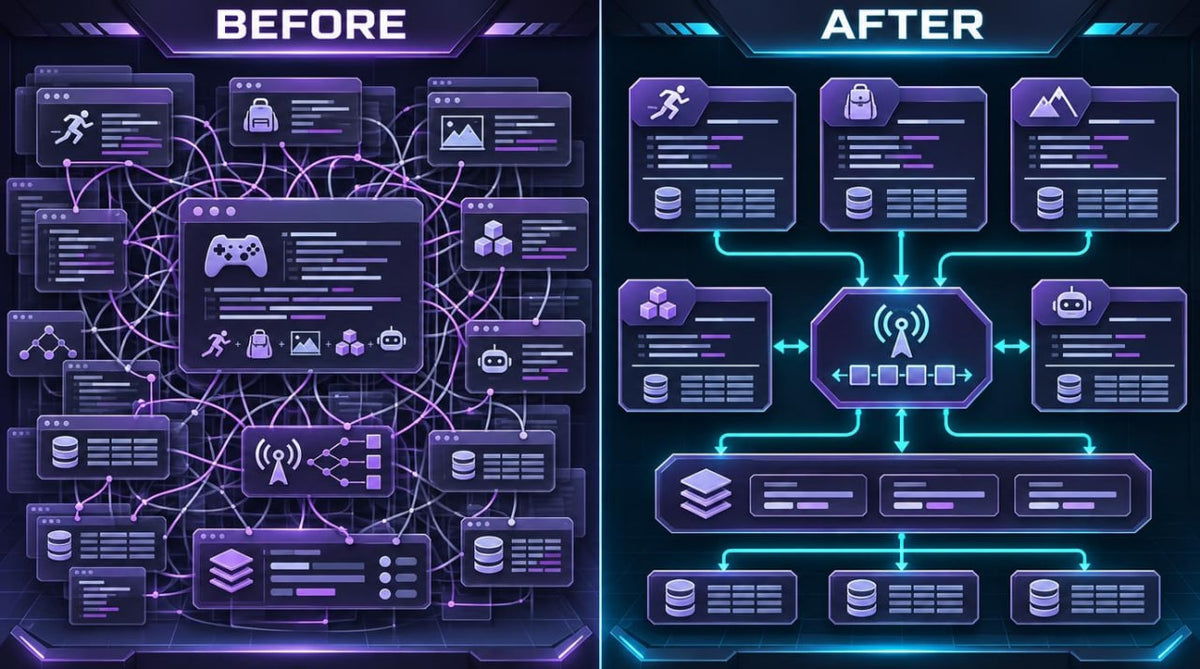
Understanding foundational game development concepts is only the beginning of working with interactive systems. Moving from theoretical ideas to practical design introduces questions about organizing gameplay actions, relationships between objects, and event sequences. Even a small game may contain several mechanics that need to respond to player actions and changes in the environment. Without a thoughtful structure, individual elements may behave inconsistently, making gameplay analysis more challenging. Further study of game development requires an understanding of how rules, responses, and states can be combined into a coherent system.
2. Solution
Vibe Set provides a structured exploration of the processes involved in designing a fundamental interactive game. Each module examines a specific game system component and explains its role within the overall experience. Educational examples demonstrate how player actions influence objects, events, and changes in game states. Practical exercises encourage learners to investigate logical relationships, describe gameplay scenarios, and identify inconsistencies in interaction rules. Through this structure, learners can gradually move from analyzing individual mechanics to preparing their own small game concept.
3. What's Inside
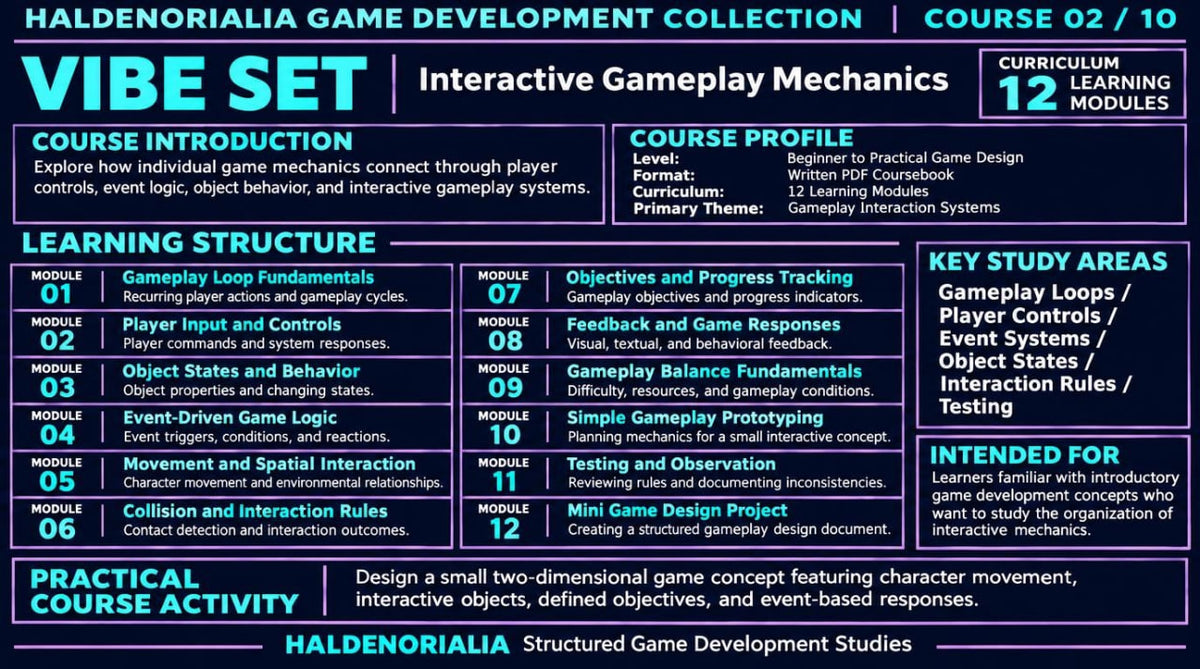
Module 1: Gameplay Loop Fundamentals
Study the structure of recurring actions that establish the central interaction process between the player and the game.
Module 2: Player Input and Controls
Examine how player interactions are interpreted as logical commands within a game system.
Module 3: Object States and Behavior
Explore how game objects change their properties and behavior according to defined conditions.
Module 4: Event-Driven Game Logic
Learn how events are organized, what conditions trigger them, and how related responses are defined.
Module 5: Movement and Spatial Interaction
Study fundamental movement rules and interactions between characters and environmental elements.
Module 6: Collision and Interaction Rules
Analyze how contacts between game objects are identified and how subsequent state changes are described.
Module 7: Objectives and Progress Tracking
Explore methods of establishing gameplay objectives, completion conditions, and progress indicators.
Module 8: Feedback and Game Responses
Examine textual, visual, and behavioral signals that communicate changes in the game environment.
Module 9: Gameplay Balance Fundamentals
Investigate relationships between difficulty, event frequency, resources, and interaction rules.
Module 10: Simple Gameplay Prototyping
Prepare the structure of a small gameplay scenario with documented mechanics, states, events, and interactions.
Module 11: Testing and Observation
Learn methods of reviewing gameplay rules, documenting errors, and analyzing system behavior.
Module 12: Mini Game Design Project
Create a design document for an original game concept describing its gameplay loop, controls, objects, and rules.
4. Who Is This For?
✅ Suitable if you:
- Already understand introductory digital game development concepts.
- Want to explore how gameplay mechanics are organized.
- Are interested in designing interaction rules between players and digital environments.
- Want to study object states, event logic, and system behavior.
- Plan to design small game concepts and educational prototypes.
- Prefer structured written materials supported by practical exercises.
- Want to learn how to document fundamental components of a game system.
❌ Not for you if you:
- Are looking for advanced instruction in large-scale game architecture.
- Want to focus entirely on three-dimensional modeling or detailed visual artwork.
- Expect a complete commercial game at the end of the course.
- Require individual real-time instructor sessions.
- Are looking exclusively for advanced game system optimization topics.
5. What You'll Learn
Throughout Vibe Set, you will explore the following concepts and practical skills:
- Gameplay loop design: Identifying recurring actions that form the foundation of gameplay.
- Control organization: Describing player commands and the corresponding responses within a game system.
- Object state design: Defining initial, intermediate, and final states for game elements.
- Event logic: Creating diagrams that connect conditions, actions, and outcomes.
- Spatial interaction: Analyzing movement, collisions, and contact between game objects.
- Gameplay objective systems: Describing tasks, completion rules, and progress tracking methods.
- Feedback mechanics: Identifying signals that communicate the current state of the game system.
- Gameplay balance fundamentals: Examining how difficulty, resources, and event frequency influence gameplay.
- Prototype planning: Preparing design documentation for a small interactive concept.
- Mechanic evaluation: Developing test scenarios and identifying contradictions between rules.
- Learning project organization: Dividing a game concept into logical components and sequential development stages.
6. Refund Policy
14-Day Refund Request Period
Refund requests for the paid Vibe Set course are reviewed according to the published Haldenorialia store policy and applicable law.
1. What format are the learning materials provided in?
1. What format are the learning materials provided in?
Haldenorialia courses are presented as written PDF coursebooks containing themed modules, explanations of technical concepts, examples, and practical exercises. The materials are organized for independent study, allowing learners to revisit individual topics and work through them at their own pace.
2. Do I need previous game development knowledge?
2. Do I need previous game development knowledge?
This depends on the course you choose. Introductory materials explain foundational game development concepts, while later courses explore more complex technical and design topics. We recommend reviewing the module descriptions and course subjects before making your selection.
Share